 b2727be8ce
Scripts: setup.sh, build.sh, serve.sh (Docker-based)
Content: about, config, software, posts sections
Custom: CSS overrides, HTML sitemap layout, extended_head partial
Theme: hugo-theme-terminal via Hugo modules (go.mod)
1.3 KiB
1.3 KiB
| title | date | draft | tags | |||
|---|---|---|---|---|---|---|
| Setting Up Hugo with Docker | 2026-04-01 | false |
|
This article is a page bundle (leaf bundle). Notice it lives at
software/hugo-setup/index.md — not hugo-setup.md.
What makes this a page bundle?
The directory structure looks like this:
content/software/hugo-setup/
├── index.md          ← this file (the page content)
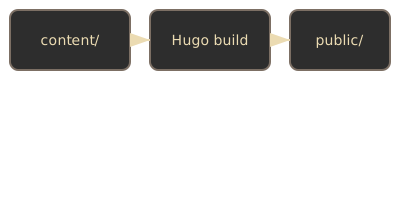
├── architecture.svg  ← co-located resource (image)
└── notes.txt         ← co-located resource (data)
Everything in this folder belongs to this page. Hugo treats the sibling
files as page resources accessible via .Resources in templates.
Why use bundles?
- Co-location: images and files live next to the article that uses them,
not in a global
static/folder. - Resource processing: Hugo can resize, crop, and fingerprint bundled images at build time.
- Portability: move or delete the folder and everything travels together.
Using a bundled image
In a template you'd access it with:
{{ $img := .Resources.GetMatch "architecture.svg" }}
{{ with $img }}
  <img src="{{ .RelPermalink }}" alt="Architecture diagram">
{{ end }}
Or reference it directly in Markdown: